An anal fistula may appear to be a small opening near the anus, but the underlying condition can be more complicated than it looks. Some fistulas involve a single tunnel, while others have multiple branches or pass through important muscles responsible for bowel control.
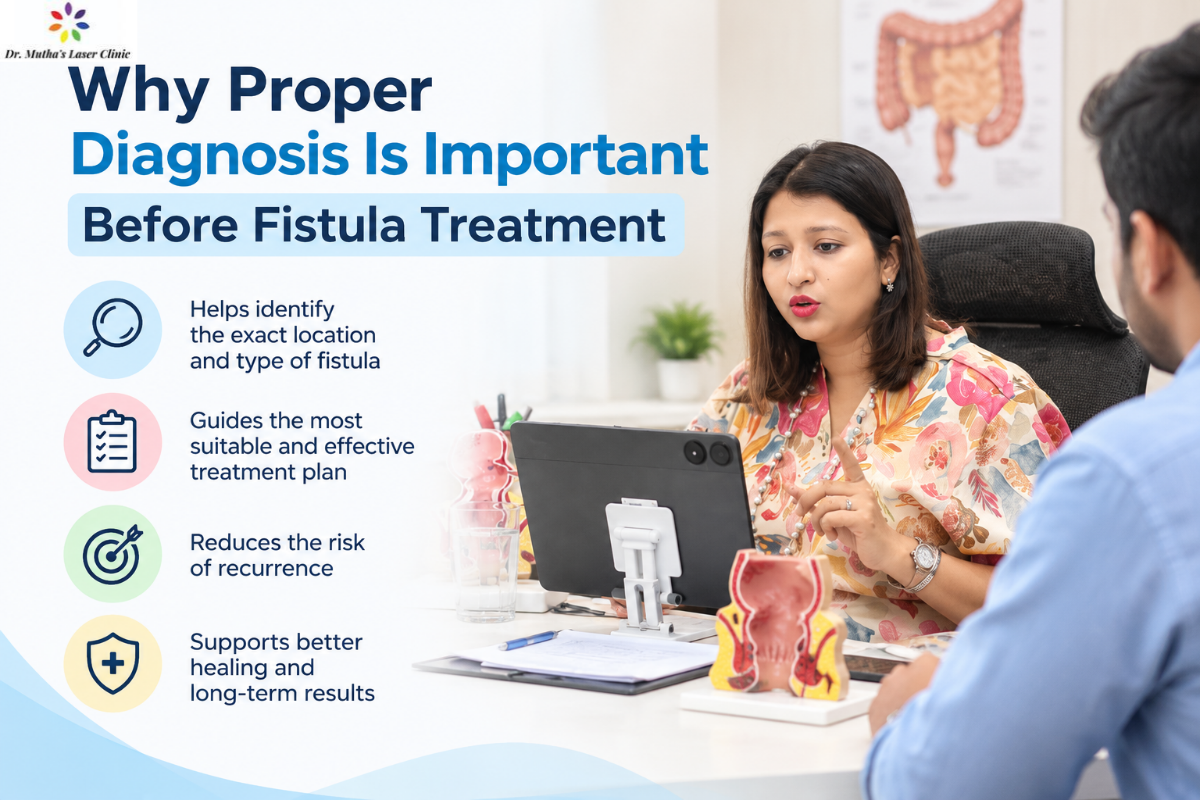
Proper diagnosis before fistula treatment is essential because it helps doctors understand the exact location, complexity, and extent of the fistula. This information guides the selection of an appropriate treatment approach while considering healing, recurrence risk, and protection of the anal sphincter muscles.
As a Fistula Specialist in Pune, I, Dr. Neha Mutha, believe that understanding the condition is an important first step towards making informed treatment decisions.
What Is an Anal Fistula?
An anal fistula is an abnormal tunnel connecting the inside of the anal canal to the skin surrounding the anus. It commonly develops after an infection in an anal gland causes an abscess.
When the abscess drains, a small tunnel may remain between the infected gland and the skin.
Common symptoms include:
- Recurrent pain or swelling near the anus
- Pus or fluid discharge
- Skin irritation or discomfort
- Repeated episodes of infection
- A small opening near the anal region
- Occasionally, bleeding or an unpleasant smell
These symptoms may also occur with other anorectal conditions. Therefore, a medical examination is necessary to identify the actual cause.
Why Is Accurate Diagnosis Important Before Treating a Fistula?
Every anal fistula is different. Selecting a treatment without understanding its anatomy may increase the risk of incomplete treatment, persistent symptoms, or complications.
1. Identifies the Exact Location of the Fistula
A fistula can develop in different positions around the anal canal.
During anal fistula diagnosis, the doctor evaluates the external opening, the likely internal opening, and the path of the fistula tract.
Understanding this anatomy helps determine whether the fistula is simple or complex and how closely it is associated with the anal sphincter muscles.
2. Helps Determine the Most Suitable Treatment
There is no single treatment that is suitable for every type of anal fistula.
Depending on the fistula’s position, complexity, and involvement of surrounding muscles, treatment options may include:
- Fistulotomy: Opening the fistula tract so it can heal, commonly considered for suitable simple fistulas.
- Seton Placement: Using a surgical thread to maintain drainage or support staged treatment.
- LIFT Procedure: Treating selected fistulas while aiming to preserve the sphincter muscles.
- Laser Fistula Treatment: A minimally invasive approach that may be considered in selected cases after assessing its suitability.
- Advancement Flap Procedure: An option for certain fistulas where cutting the sphincter muscles could create additional risks.
The most appropriate procedure depends on the clinical findings. Laser treatment is not necessarily suitable for all fistulas, and no procedure can guarantee permanent success.
3. Helps Assess the Risk of Fistula Recurrence
One of the concerns associated with fistula treatment is recurrence.
A fistula may return if infection persists, an underlying branch remains untreated, or the condition is particularly complex.
A careful pre-treatment evaluation helps identify additional tracts, abscesses, and other factors that may influence treatment outcomes.
Although recurrence cannot always be prevented, accurate diagnosis supports better surgical planning.
4. Helps Protect the Anal Sphincter Muscles
The anal sphincter muscles help control bowel movements.
Some fistulas pass through or around these muscles, making treatment more challenging.
An accurate diagnosis allows the surgeon to assess how much of the sphincter complex is involved and consider treatment options that minimize the risk of bowel-control problems.
Preserving normal function is an important part of fistula surgery planning.
5. Helps Identify Underlying Health Conditions
Most anal fistulas develop after an anal abscess. However, some are associated with conditions such as Crohn’s disease or other inflammatory and infectious disorders.
Recognizing these possibilities is particularly important in patients with recurrent, multiple, or complex fistulas.
When required, further investigations or specialist assessment may be recommended.
How Is an Anal Fistula Diagnosed?
The diagnostic process depends on the patient’s symptoms, examination findings, and medical history.
Physical Examination
The doctor examines the area around the anus for visible openings, swelling, tenderness, discharge, and signs of infection.
A gentle rectal examination may also be performed when appropriate.
Proctoscopy
A proctoscopy allows the doctor to examine the anal canal and lower rectum using a specialized instrument.
It may help assess associated conditions and identify relevant abnormalities.
MRI Scan
An MRI for anal fistula may be recommended when the fistula is complex, recurrent, difficult to assess clinically, or associated with suspected deeper infection.
MRI can help demonstrate the fistula’s course, secondary branches, and surrounding structures.
However, an MRI is not required for every patient with a fistula.
Endoanal Ultrasound
In selected cases, an endoanal ultrasound may help assess the fistula tract and its relationship with the anal sphincter muscles.
Examination Under Anaesthesia
Sometimes, a detailed examination under anaesthesia is necessary to establish the anatomy of the fistula and plan or perform treatment.
The decision to use additional investigations is based on individual clinical needs.
Can Fistula Treatment Be Started Without an MRI?
Yes. An MRI is not mandatory for every anal fistula.
In many straightforward cases, an experienced surgeon can assess the condition through medical history and clinical examination.
However, imaging may be useful when a fistula is recurrent, complex, or difficult to map accurately.
The important factor is not whether every patient undergoes an MRI, but whether the doctor has sufficient information to recommend an appropriate treatment.
What Happens If an Anal Fistula Is Left Untreated?
An anal fistula rarely heals permanently on its own.
Without appropriate treatment, patients may experience repeated infections, discharge, pain, or abscess formation.
Symptoms sometimes improve temporarily when pus drains, but this does not necessarily mean the underlying fistula has healed.
Persistent symptoms should be evaluated rather than repeatedly managed with home remedies or medicines alone.
Seek prompt medical attention if anal pain or swelling is accompanied by fever, rapidly increasing redness, or severe discomfort, as these may indicate an abscess requiring urgent assessment.
Fistula Diagnosis and Treatment in Pune by Dr. Neha Mutha
Patients experiencing recurring anal pain, swelling, or discharge may benefit from an evaluation by a qualified proctology specialist.
At Dr. Neha Mutha, the focus is on understanding the patient’s symptoms, examining the affected area, and discussing appropriate diagnostic and treatment options.
As a Proctologist in Pune, I emphasize clear communication, individualized treatment planning, and explaining the possible benefits and limitations of different procedures.
Patients seeking Fistula Treatment in Pune can consult Dr. Neha Mutha at the clinic locations in Kharadi and Magarpatta.
Frequently Asked Questions About Fistula Diagnosis
1. Why is diagnosis important before fistula surgery?
Accurate diagnosis helps identify the fistula’s location, branching pattern, and relationship with the sphincter muscles. These details guide treatment selection and help assess potential risks.
2. Is an MRI necessary before every fistula operation?
No. MRI is generally considered for selected cases, particularly complex or recurrent fistulas. Many straightforward fistulas can be evaluated clinically.
3. Can a fistula be mistaken for piles?
Yes. Some symptoms, including discomfort, swelling, or bleeding, can overlap. However, piles and anal fistulas are different conditions that require different treatment approaches.
4. Can a fistula return after surgery?
Yes. Recurrence is possible, particularly in complex cases. Accurate assessment, appropriate treatment selection, and follow-up care can help address factors associated with recurrence.
5. Is laser treatment suitable for every anal fistula?
No. Laser treatment may be considered for selected patients, but suitability depends on the anatomy and complexity of the fistula. Other procedures may offer more appropriate treatment for some patients.
6. Which doctor should I consult for anal fistula symptoms?
A qualified colorectal surgeon or proctologist can evaluate the symptoms, confirm the diagnosis, and explain suitable treatment options.
Conclusion
An anal fistula should not be treated based only on its visible opening or temporary symptoms.
Understanding the fistula’s complete anatomy, associated infection, and relationship with the sphincter muscles is essential for selecting an appropriate treatment.
Early evaluation and individualized surgical planning can help patients make informed decisions and understand the potential benefits, risks, and recovery expectations.
If you are experiencing repeated swelling, discomfort, or discharge near the anus, consult Dr. Neha Mutha, Fistula Specialist in Pune, for a clinical evaluation and guidance regarding available treatment options.
Book a Consultation with Dr. Neha Mutha
Clinic Locations: Kharadi and Magarpatta, Pune
Contact: +91 87882 51988
Website: https://drmuthalaserclinic.com/
Medical Disclaimer: This article is intended for general patient education and does not replace an individual medical consultation. Diagnosis and treatment recommendations vary depending on clinical findings and medical history.