An anal fistula can be an uncomfortable condition to talk about, and many patients initially hope that it will settle on its own. Some notice that pain or discharge improves for a few days and assume that the problem has healed. However, temporary improvement does not necessarily mean that the fistula tract has closed.
As a doctor treating anorectal conditions, I believe patients should understand why an anal fistula develops, why symptoms can come and go, and when medical evaluation becomes important.
What Is an Anal Fistula?
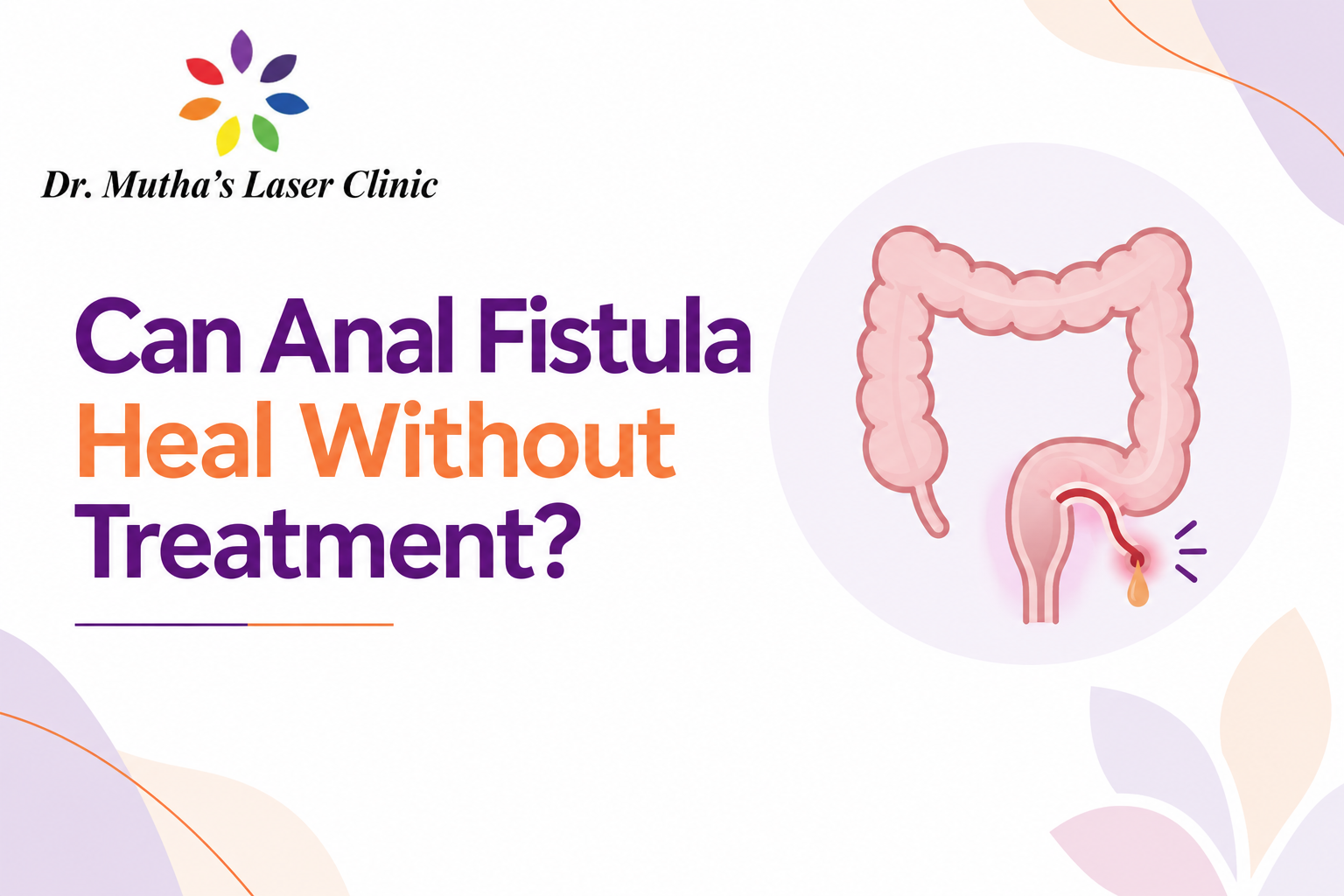
An anal fistula is an abnormal tunnel that develops between the anal canal and the skin around the anus. It commonly develops following an infection or anal abscess. After an abscess drains, either naturally or through treatment, a tract may remain between the infected gland and the skin.
This tract can continue to produce intermittent discharge, swelling, irritation or discomfort.
Can an Anal Fistula Heal on Its Own?
In most cases, an anal fistula is unlikely to heal completely without appropriate treatment. Established patient guidance notes that anal fistulas rarely heal by themselves and frequently require a procedure or surgery.
One reason patients may think the fistula has healed is that its external opening can temporarily stop draining. Pain and swelling may also decrease.
But symptom relief does not always mean that the internal fistula tract has disappeared.
If the underlying tract remains, symptoms may return later.
Why Do Fistula Symptoms Keep Coming Back?
A typical pattern can involve swelling followed by discharge of pus or fluid. Once the accumulated fluid drains, pressure decreases and the patient may temporarily feel better.
If the fistula remains, however, drainage, irritation or infection can recur. Recent NHS patient guidance similarly notes that symptoms may improve when a fistula drains but can return if the fistula does not heal.
That is why recurrent discharge from the same area should not simply be ignored because the pain has reduced.
Symptoms That Need Medical Evaluation
You should consider consulting a doctor if you experience persistent or recurring symptoms such as:
- Pain or swelling around the anus
- Repeated pus or foul-smelling discharge
- Blood-stained discharge
- Skin irritation around an opening near the anus
- Recurrent abscess in the same area
- Fever associated with increasing pain or swelling
Pain, swelling, irritation, discharge and bleeding are among the recognized symptoms of an anal fistula.
Severe pain accompanied by fever or feeling unwell deserves prompt medical attention because an infection or abscess may be present.
How Is an Anal Fistula Diagnosed?
The first step is a clinical examination. Depending on the symptoms and suspected complexity of the fistula, further evaluation may sometimes be advised.
Investigations such as an MRI fistulogram or other imaging may be useful in selected complex or recurrent cases to understand the fistula’s pathway and relationship with surrounding structures.
Correctly understanding the tract is important because every fistula is not the same.
Does Every Fistula Need the Same Treatment?
No. Treatment should be individualized.
A fistula may be relatively simple and superficial, while another may pass through or close to the anal sphincter muscles. Some fistulas can also have multiple branches.
Depending on the individual case, treatment approaches can include advancement flap procedures and selected minimally invasive approaches. Laser-based procedures are also among the techniques used for certain fistulas.
The appropriate option depends on factors such as the location and complexity of the tract, previous treatment, infection and involvement of the sphincter muscles.
The objective is not simply to close the external opening. Treatment planning also considers controlling infection, addressing the fistula tract and protecting bowel-control function.
What About Laser Treatment for Anal Fistula?
Patients frequently ask me whether a fistula can be treated using a laser or another minimally invasive technique.
Laser treatment is one of several available approaches, but it is not automatically the right option for every fistula. The anatomy and complexity of the fistula need to be assessed before deciding which procedure is suitable. NHS guidance notes that laser treatment can be used to seal a fistula tract, while also acknowledging uncertainty regarding its effectiveness compared with established approaches.
This is why treatment should be selected after proper evaluation rather than choosing a procedure based only on its name.
Why Waiting for a Fistula to Heal Naturally May Not Be the Best Approach
Because symptoms can temporarily settle, some patients continue waiting for weeks or months. The difficulty is that a persistent tract can continue to cause episodes of drainage or infection.
Early evaluation does not necessarily mean that an immediate procedure will be required. It allows the doctor to understand the condition and discuss appropriate options based on the patient’s individual findings.
Consult Dr. Neha Mutha in Pune
At Dr. Mutha’s Laser Clinic, Pune, I, Dr. Neha Mutha, provide evaluation and treatment for anorectal conditions including anal fistula, piles, anal fissure and pilonidal sinus.
If you have recurrent pain, swelling, pus discharge or an opening near the anus that repeatedly drains and closes, consider getting it evaluated rather than waiting indefinitely for it to disappear.
The appropriate treatment for an anal fistula depends on its type and complexity. A clinical examination can help determine the next step and whether further investigation or treatment is required.
Medical Disclaimer: This article is intended for general patient education and does not replace an individual medical consultation, diagnosis or treatment recommendation.