
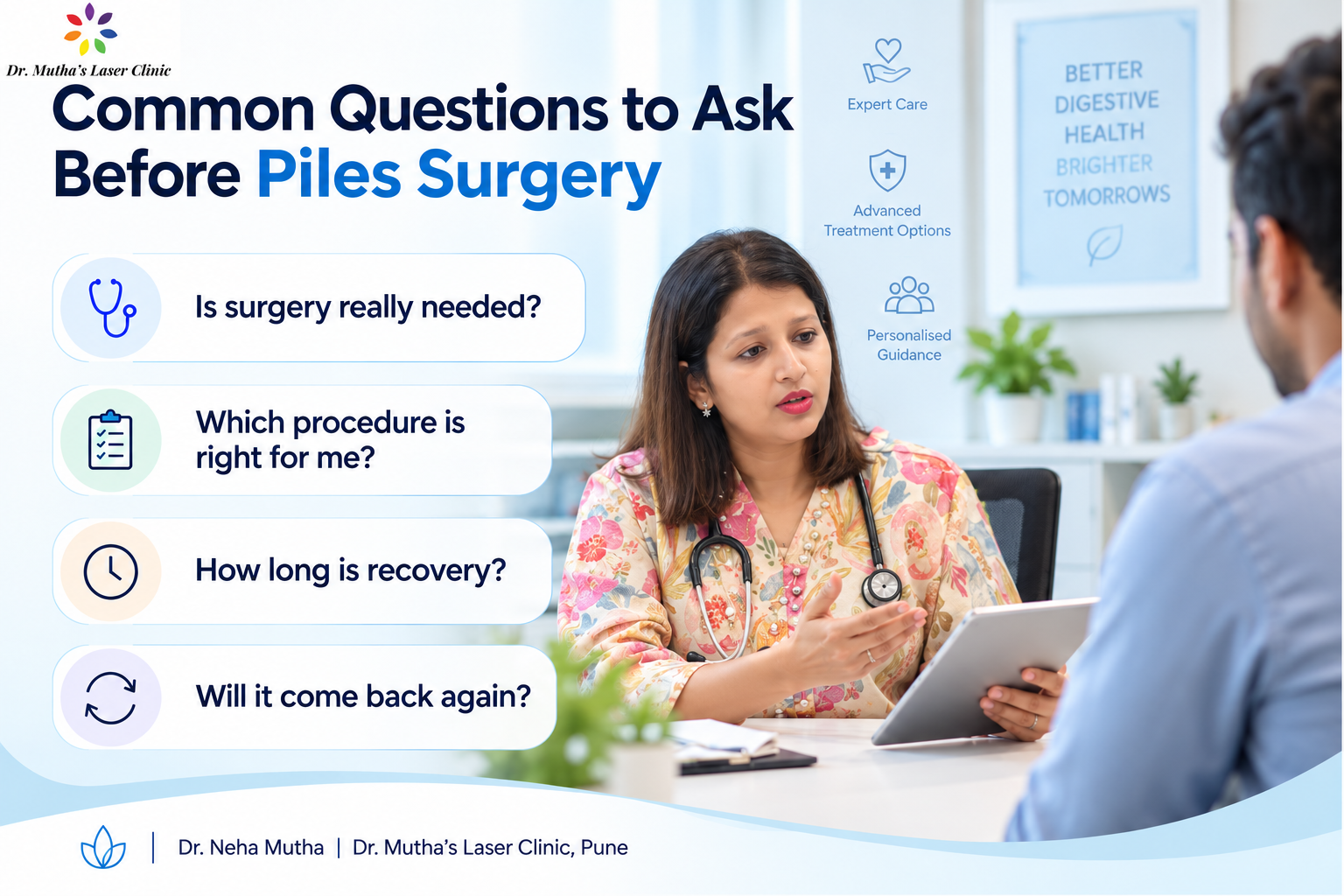
Piles, also known as hemorrhoids, are a common condition that can cause discomfort, itching, swelling, and bleeding during bowel movements. While many people experience relief through lifestyle changes and medicines, some may require medical procedures or surgery to manage persistent symptoms.
If your doctor has recommended surgery, it is natural to have questions about the procedure, safety, recovery time, and long-term results. Understanding your treatment options can help you make an informed decision.
At Dr. Mutha’s Laser Clinic, Pune, Dr. Neha Mutha provides evaluation and treatment guidance for patients experiencing piles and other anorectal conditions.
In this blog, we discuss the important questions patients should ask before undergoing piles surgery.
1. Is Piles Surgery Really Necessary?
One of the first questions to ask your doctor is whether surgery is required for your condition.
Not every patient with piles needs surgery. Mild symptoms can often be managed through:
-
Eating fibre-rich foods
-
Drinking adequate water
-
Avoiding straining during bowel movements
-
Managing constipation
-
Using doctor-prescribed medicines
-
Following appropriate toilet habits
However, surgery or an outpatient procedure may be considered when symptoms persist despite treatment, hemorrhoids prolapse significantly, or repeated bleeding affects daily life.
Dr. Neha Mutha, a proctologist in Pune, assesses the severity of the condition, symptoms, and medical history before discussing suitable treatment options.
2. Which Piles Surgery Procedure Is Right for Me?
Different procedures are available for treating piles. The appropriate option depends on the grade, location, and severity of hemorrhoids.
Common treatment options include:
Rubber Band Ligation: A minimally invasive outpatient procedure commonly used for selected internal hemorrhoids. A small rubber band cuts off the blood supply, allowing the treated tissue to shrink.
Laser Hemorrhoid Treatment: Uses laser energy to treat selected hemorrhoidal tissue. Suitability depends on the type and severity of piles.
Hemorrhoidectomy: A surgical procedure that removes hemorrhoidal tissue. It may be recommended for large, advanced, or complicated hemorrhoids.
Stapled Hemorrhoidopexy: A procedure used in selected cases of prolapsing internal hemorrhoids. It is not suitable for every type of piles.
Patients considering Laser Piles Treatment in Pune should discuss the advantages, limitations, possible complications, recurrence risk, and expected recovery associated with each technique.
The best procedure is not necessarily the newest one. It is the one most appropriate for your individual condition.
3. How Long Does Recovery Take After Piles Surgery?
Recovery time is one of the most common concerns among patients.
The duration depends on the procedure performed, the severity of hemorrhoids, the patient’s overall health, and the nature of their daily activities.
Some patients undergoing outpatient procedures may return to routine activities relatively quickly, while recovery after conventional hemorrhoidectomy can take several weeks.
During recovery, your doctor may recommend:
-
Taking prescribed medicines as directed
-
Maintaining a fibre-rich diet
-
Drinking sufficient fluids
-
Avoiding straining during bowel movements
-
Taking warm sitz baths when advised
-
Temporarily avoiding heavy lifting or strenuous activities
Ask your surgeon when you can return to work, exercise, driving, and normal daily activities. Recovery instructions should be personalised rather than based on a fixed timeline.
4. Will Piles Come Back After Surgery?
Another important question is whether hemorrhoids can return after treatment.
Piles can recur even after a successful procedure. The risk varies depending on the treatment used, the original condition, and factors such as ongoing constipation or straining.
To help reduce the likelihood of recurring symptoms, patients should:
-
Maintain regular bowel habits
-
Avoid prolonged sitting on the toilet
-
Eat enough dietary fibre
-
Stay adequately hydrated
-
Exercise regularly
-
Seek medical advice for persistent constipation
No procedure can guarantee that piles will never recur. Discussing the possibility of recurrence with your surgeon helps establish realistic expectations.
5. Is Piles Surgery Painful?
Pain and discomfort vary depending on the procedure.
Some minimally invasive treatments may cause relatively mild discomfort, while conventional hemorrhoidectomy can involve more significant postoperative pain.
Your doctor will explain the appropriate anaesthesia and pain management options.
Before surgery, ask about the expected discomfort, prescribed pain-relief medicines, and symptoms that may require medical attention.
6. What Are the Possible Risks and Complications?
Every medical procedure has potential risks, and piles surgery is no exception.
Possible complications may include:
-
Bleeding
-
Infection
-
Temporary difficulty passing urine
-
Postoperative pain
-
Delayed wound healing
-
Recurrence of hemorrhoids
-
Rare complications such as anal narrowing or changes in bowel control
Not every patient experiences these complications. The risks vary according to the procedure and individual health factors.
A detailed discussion with your surgeon helps you understand the potential benefits and limitations before giving consent.
7. What Tests Are Needed Before Piles Surgery?
Your surgeon may recommend an examination and selected investigations based on your symptoms and medical history.
Evaluation may include:
-
Clinical examination of the anal region
-
Digital rectal examination, when appropriate
-
Anoscopy or proctoscopy
-
Blood tests when indicated
-
Colonoscopy in selected patients, particularly when bleeding requires further investigation
Importantly, rectal bleeding should not automatically be assumed to be caused by piles. Other conditions can produce similar symptoms and may need evaluation.
8. What Should I Eat Before and After Surgery?
Diet plays an important role in maintaining comfortable bowel movements.
Your doctor may advise including fibre-rich foods such as fruits, vegetables, whole grains, and pulses, along with adequate fluids.
After surgery, dietary instructions may depend on the procedure and anaesthesia used. Keeping stools soft can help minimise straining during recovery.
Patients should also ask whether they need stool softeners or fibre supplements.
9. When Should I Seek Medical Attention After Surgery?
Before discharge, ask your surgeon which postoperative symptoms are expected and which require urgent assessment.
Contact your healthcare team promptly if you experience increasing pain, fever, difficulty passing urine, or bleeding beyond what your surgeon has advised is normal.
Seek urgent medical care for heavy bleeding, fainting, or severe symptoms.
Knowing these warning signs in advance can make recovery safer and less stressful.
10. How Do I Choose the Right Doctor for Piles Surgery?
Choosing an appropriately qualified and experienced surgeon is an important part of treatment planning.
Consider asking about the doctor’s experience with different hemorrhoid procedures, the reasons for recommending a particular approach, postoperative follow-up, and management of possible complications.
Patients looking for Piles Surgery in Pune can consult Dr. Neha Mutha at Dr. Mutha’s Laser Clinic to discuss their symptoms, diagnosis, and available treatment options.
Frequently Asked Questions About Piles Surgery
Can piles be treated without surgery?
Yes. Many patients with mild or moderate hemorrhoid symptoms improve with dietary changes, constipation management, medication, or outpatient procedures. Surgery is generally considered when clinically appropriate.
Is laser piles surgery suitable for everyone?
No. Laser treatment may be considered for selected patients, but conventional surgery or other procedures may be more appropriate in some cases.
How soon can I return to work after piles surgery?
The timeline depends on the type of procedure, postoperative discomfort, and your job requirements. Your surgeon can provide individualised advice.
Can piles return after laser surgery?
Yes. Recurrence is possible after laser treatment and other hemorrhoid procedures. Long-term bowel habits and the type of hemorrhoids can influence recurrence risk.
Is bleeding after piles surgery normal?
A small amount of bleeding may occur during recovery, depending on the procedure. Heavy, persistent, or worsening bleeding requires prompt medical assessment.
Can piles surgery permanently cure hemorrhoids?
Treatment can successfully address existing hemorrhoids, but no surgical technique guarantees permanent freedom from recurrence.
Conclusion
Preparing for piles surgery involves more than choosing a treatment method. It is important to understand why surgery is recommended, which procedure may be suitable, what recovery involves, and what risks or complications to expect.
Asking the right questions allows patients to make informed decisions and prepare for treatment with realistic expectations.
If you are experiencing persistent hemorrhoid symptoms, Dr. Neha Mutha at Dr. Mutha’s Laser Clinic, Pune, can help evaluate your condition and discuss appropriate management options.
Visit: https://drmuthalaserclinic.com/
Medical Disclaimer: This article is intended for general educational purposes and does not replace professional medical advice, diagnosis, or treatment. Individual treatment recommendations depend on clinical evaluation.